
Pakistani Canadian Tahawwur Hussain Rana, co-accused in the Mumbai terror attack case, was arraigned in Chicago on Thursday for the trial that is set to begin on May 16. Rana's attorney Patrick Blegen told judge Leinenweber that he required time to translate about a 1000 pages of Urdu text in preparation for the trial set for May 16
The status hearing of Pakistani born Canadian citizen Tahawwur Hussain Rana, co-accused with David Coleman Headley in the 2008 Mumbai terror attacks took in Chicago on Wednesday, even as his lawyer claimed that Indian government officials hadn't approached him yet for access.
The FBI on Monday submitted fresh evidence against Pakistan-born terror suspect Tahawwur Hussain Rana alleging that he "knew well in advance" that Lashkar terrorists would strike Mumbai in November 2008.
The trial of Tahawwur Hussain Rana, co-accused along with Lashkar-e-Tayiba terrorist David Headley in 2008 Mumbai attacks, has been postponed from February 14 to May 16 at the request of defence.
The hearing of the bail application of Tahawwur Hussain Rana, a Pak-born Canadian citizen arrested on terrorist charges, has been postponed by a week.
Pakistani-Canadian LeT operative Tahawwur Hussain Rana has appeared in a Chicago court for his arraignment and pleaded not guilty to the charges of conspiring to provide material support to the 26/11 Mumbai attacks and a terror plot in Denmark.
An attack on India's National Defence College was discussed by suspected LeT operatives David Coleman Headley and Tahawwur Hussain Rana, who offered praise for the terror outfit LeT and said he "appreciates them from heart", US prosecutors alleged on Monday.
India is likely to get access to Tahawwur Hussain Rana, the Pakistani Canadian accused in the Mumbai terror attack case, after completion of his trial in an American court next month.
After the terror attacks in Mumbai last year, terror suspect Tahawwur Hussain Rana complimented members of the Lashkar-e-Tayiba, saying they had done a 'good job', United States prosecutors have alleged. According to a 10-page memo filed by United States prosecutors in a Chicago court on Monday, Rana asked co-conspirator David Coleman Headley to "pass along a message" to LeT Member A, whom Rana had given the name 'Khalid bin Waleed'.
Freezing or calling off the re-engagement process in the wake of Tahawwur Hussain Rana's confession on 26/11 will be an easy option, but that will take both India and Pakistan back into stewing in their past, feels strategic expert B Raman

'The fight against terrorism will continue. We have set a new normal and the new normal is that we will follow an offensive strategy. Wherever terrorists are, we have to kill those terrorists and we have to destroy their infrastructure. So it is still not over but as we speak the ceasefire is still intact'
The US has said it is in communication with both India and Pakistan on the case of Lashkar-e-Tayiba operatives David Coleman Headley and Tahawwur Hussain Rana, who were arrested by the Federal Bureau of Investigation in October on charges of plotting terror attacks against Indian facilities.
A senior source in Mumbai police aggressively argued that revelations in the David Coleman Headley and Tahawwur Hussain Rana case by newly-formed National Investigation Agency and the Federal Bureau of Investigation of US is not going to affect the 26/11 case which is being heard in the special court set up at the Arthur Road jail in Mumbai.

'He is the key to unravel the 26/11 conspiracy.'

India's National Investigation Agency is probing into his role in the 26/11 attacks carried out by Pakistan-based Lashkar-e-Taiba terrorists in 2008.
The United States has extradited Pakistani-Canadian Tahawwur Hussain Rana to India to face charges for his alleged involvement in the 2008 Mumbai terrorist attacks. Rana, 64, was convicted in the US in 2011 for providing material support to Lashkar-e-Taiba, the Pakistani militant group responsible for the Mumbai attacks. The US Department of State said it has long supported India's efforts to bring those responsible for the attacks to justice and that the extradition is a critical step towards seeking justice for the victims. Rana's extradition comes after the US Supreme Court denied his last-ditch attempt to evade extradition. He will now face justice in India for his role in the attacks which killed 166 people, including six Americans.
Senior analyst B Raman on how India should react to 26/11 accused David Headley's testimony in co-accused Tahawwur Hussain Rana's ongoing trial in a Chicago court.
The terrorist duo David Colman Headley and Tahawwur Hussain Rana had planned to blast two major temples in Kerala -- the Sabarimala Ayyappa temple and Guruyaur Sreekrishna Swami temple -- to spread panic in the state and country, central intelligence sources told rediff.com.

Headley also said that LeT boss Hafiz Saeed, the mastermind behind the November 2008 attack that killed 166 persons, motivated him for carrying out a 'jihad'. Saeed told him that the satisfaction of one second of 'jihad' is equal to "100 years of worship."
India has asked the United States to provide statements of 13 people associated with Lashkar-e-Tayiba terrorist David Headley and his accomplice in Mumbai terror attack case Tahawwur Hussain Rana as they could be potential witnesses.

David Coleman Headley and Tahawwur Hussain Rana, arrested last month by the Federal Bureau of Investigation, were part of a Lashkar-e-Tayiba plan of a major terror attack on the facilities of a Danish newspaper and the National Defence College in India, federal prosecutors have said.
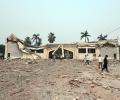
A total of nine terror sites in Pakistan, including five in Pojk, linked to Lashkar-e-Taiba (Let) and Jaish-e-Mohammed (Jem), were targeted with meticulous planning to avoid civilian casualties.
The sentencing of Lashkar-e-Tayiba operative David Coleman Headley is expected to happen only by early next year, after the trial of co-accused Pakistani-Canadian Tahawwur Hussain Rana is complete, Headley's lawyer said in Chicago.
The United States on Tuesday said that it was working closely with India on the Headley-Rana case to detect and prevent future terror attacks. Lashkar-e-Tayiba operatives David Headley and Tahawwur Hussain Rana were arrested by the Federal Bureau of Investigation from Chicago in October for plotting terror attacks in India and Denmark.
Senior Police Inspector Ramesh Mahale tells Sheela Bhatt that the Headley-Rana angle will not affect his case.
In the wake of the confession by Canadian Pakistani Lashkar-e-Tayiba operative Tahawwur Hussain Rana, the Bhartiya Janata party asked the government to not hold any talks with Pakistan.
Pakistan's Consul General in Chicago personally knew both David Coleman Headley and Tahawwur Hussain Rana, nabbed by the Federal Bureau of Investigation for planning to carry out a major terror attack in India at the behest of LeT, the US authorities have claimed.
Speaking at a hearing of the Foreign Relations Committee, Maryland Democrat Ben Cardin, a member of the Senate Foreign Relations Committee, said: "There are mixed signals here that are very, very troubling and that the United States needs to be able to have alternatives for carrying out its foreign policy in that region."
"We have asked the Pakistani government to address those allegations in the past," State Department spokesman Mark Toner told media persons when asked about the alleged involvement of Pakistan's Inter Services Intelligence (ISI) in the Mumbai terrorist attacks.
Lashkar-e-Tayiba operative David Coleman Headley, a Pakistani-origin American citizen charged with criminal conspiracy in the Mumbai terror attacks, could face the 'maximum statutory penalty' of life imprisonment or death if convicted.This was contained in additional charges unsealed at a Chicago court, which is hearing the case against 49-year-old Headley, who was arrested by the Federal Bureau of Investigation in October, along with LeT operative Tahawwur Hussain Rana.
Seeking to downplay the inability of Indian officials to get access to suspected terrorist David Headley, the government on Tuesday said it has received a full report from US investigators and has advised them on what lines further probe was required.

India is likely to press for access to Tahawwur Hussain Rana, and wife and two girlfriends of Mumbai attack terrorist David Headley during Home Minister Sushilkumar Shinde's visit to the United States next week.
Charged with conspiring in the 26/11 Mumbai terror attacks, Pakistani-American Lashkar-e-Taiyba operative David Coleman Headley will be produced in a Chicago court on Wednesday, where he will respond to the charges against him. Headley is set to appear for his arraignment before US Magistrate Judge Arlander Keys in United States district court, Northern District of Illinois. Co-accused Tahawwur Hussain Rana appeared in the same court on Monday and pleaded not guilty.
A joint team of the US department of justice and the Federal Bureau of Investigation briefed Indian investigators on American terror suspect David Headley's alleged role in last year's Mumbai terror strike on Monday.
A Chicago court has given a 60-day deadline to the Federal Bureau of Investigation to complete its investigations and file an indictment into the foiled terror plot in India and Denmark by Pakistan-based Lashkar-e-Tayiba terrorist group.

Giving a new dimension to the Lashkar-e-Tayiba plot to attack Indian facilities, Federal Bureau of Investigation's sleuths have recovered two inflammatory Al Qaeda videos, containing speeches by Osama bin Laden and other terrorists, from the house of Pakistan-born Canadian Tahawwur Hussain Rana, who was arrested in October. Produced by 'As Sahab Media', commonly acknowledged to be the media wing of the Al Qaeda, one of the videos is titled 'Bombing of Denmark Embassy'.
Lashkar-e-Tayiba operative David Coleman Headley on Wednesday told a United States court that he had conducted a surveillance of the German Bakery in Pune and identified Chabad houses in Delhi, Pushkar and Pune which could be bombed.

Rana was arrested in 2009 on the charges of plotting the 26/11 terror attack. Some 166 people, including US nationals, were killed in the attack carried out by 10 Pakistan-based Lashkar-e-Tayiba terrorists. Nine of the attackers were killed by police while lone survivor Ajmal Kasab was captured and hanged after handed down death sentence by an Indian court.
In the wake of the Pune blast, the Gujarat police is keeping a close watch over all the places in the state which US terror suspect David Headley's accomplice had visited in November 2008.
In respect of all other charges relating to the Mumbai attack, Headley is the only accused. No one else has been cited as co-accused.
 © 2026 Rediff.com - Advertise with us - Disclaimer - Privacy Policy - Sitemap - Feedback - About us - Terms of use - Grievances